

Stop Restaurant Revenue Leakage: Why Integrating Table KOT Directly with Room Folios Saves 8–12% in Margins
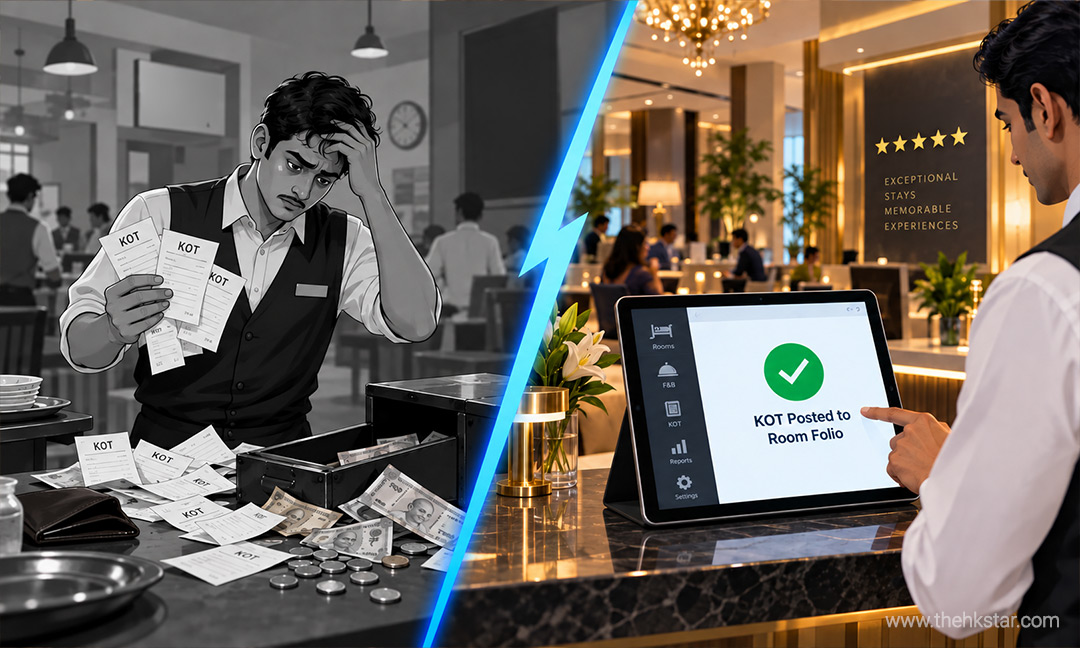
Managing multi-outlet dining and in-room service without operational leakage is a continuous issue in the high-stakes hospitality sector. The gap between front desk operations and food service causes thousands of dollars in unpaid room service, lost Kitchen Order Tokens (KOTs), and contested checkout bills for hoteliers and restaurateurs operating on-site dining. There is a lot of friction when using standalone billing devices or conventional manual slips. Modern facilities are using integrated restaurant billing software, which links table KOTs directly with central room folios, to stop these costly outflows. This is how 8–12% of gross operational margins are recovered and revenue leakage is eliminated by direct folio integration.
The Hidden Cost of Disconnected Restaurant Billing
Operational problems are unavoidable when a hotel’s restaurants, bars, and room service run on separate systems:
Unbilled In-Room Dining:
Manual room service KOTs frequently disappear before they arrive to the front desk, leaving meals unbilled when guests check out.
Disputed Guest Bills:
During check-out, customers frequently contest charges due to handwritten bills or delayed printed updates, which can result in forced discounts or written-off profits.
Manual Entry Errors:
When employees manually re-enter dining bills into the primary property management system (PMS), they may type them incorrectly.
Inventory & Stock Mismatches:
Disconnected Point-of-Sale (POS) locations prevent cost control and real-time ingredient tracking.
How Direct KOT-to-Room Folio Integration Works
The workflow completely alters if a restaurant billing system is integrated into the hotel’s Cloud PMS:
- Digital KOT Generation: When a guest orders at the restaurant, bar, or via room service, the waiter inputs the order via a tablet or mobile device.
- Instant Kitchen Routing: The digital KOT routes instantly to the Kitchen Display System (KDS) or printer.
- Automated Folio Posting: If the guest opts to “Charge to Room,” the software verifies room status, guest name, and credit limit in real time, immediately posting the charge to the guest’s master bill.
4 Key Ways Direct KOT Integration Protects Your Margins
- It closes the unbilled-charge gap – There is no human step left to make a mistake when postings are made automatically from the kitchen terminal or table. Each coffee, side dish, and mini-bar item is immediately recorded on the folio.
- It speeds up checkout – While a customer waits at the counter, front desk employees are not phoning the restaurant or going through slips. The correct and GST-ready itemized bill is already there.
- It shuts down a common fraud path – Unrecorded cash and quiet bill modifications take place in manual systems. With a digital trail, reconciliation is no longer a guessing game because every action is recorded.
- It tightens up the kitchen’s numbers – Waste, overordering, and small-scale theft appear in the data rather than remaining undetectable because each KOT automatically subtracts inventory from the recipe; this is frequently worth an additional 3–5% on F&B expenses alone.
Conclusion
Fragmented operational tools and manual paper KOTs silently drain hotel profits every day. Upgrading to a feature-rich restaurant billing software that integrates KOT generation straight into guest room folios. It ensures accurate billing, protects profit margins, and speeds up guest checkouts. By adopting unified solutions like HK Star Cloud, hotel owners can plug revenue leaks effortlessly and boost gross operating margins by 8–12%.