

The Indian Hotelier’s Guide to 100% GST Compliance: Handling Multi-Slab Billing, Corporate Invoicing & Night Audits
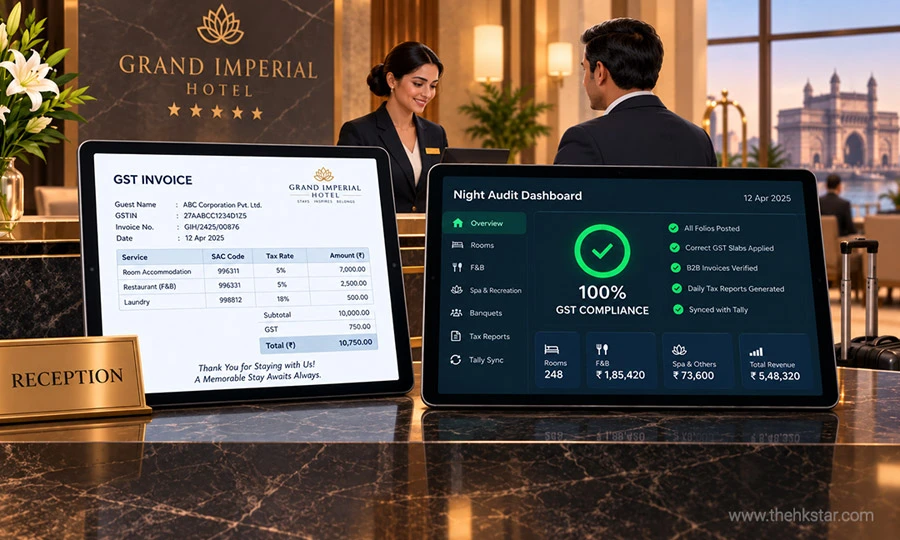
Making guests feel at home and adhering to an ever-changing tax framework are two tasks that hotel managers in India must perform simultaneously. Hoteliers no longer need to print a receipt at the register to comply with the GST Council’s rules. These days, it entails keeping track of which tariff slab a room belongs to, maintaining departmental sales segregation, accurately preparing corporate B2B invoices, and closing the accounts every night. Anywhere along the chain, missing a step could result in fines or covert money leakage.
To maintain an audit-ready property, hoteliers must leverage modern GST hotel billing software integrated with a robust Cloud PMS. This complete guide breaks down how GST hotels in India can ensure 100% GST compliance without slowing down front-desk operations.
1. Master the Multi-Slab GST Structure in Hotel Billing
One tax rate applies to the majority of retail firms. That luxury is uncommon in hotels, where a single guest’s bill may reach two or three slabs prior to check-out. As of right now:
- Room tariff up to ₹7,500/night — 5% GST, no input tax credit
- Room tariff above ₹7,500/night — 18% GST, full ITC eligibility
- Restaurant dining and room service — 5% GST for non-specified premises, 18% for specified premises
- Laundry, banquets, spa and other add-ons — generally 18%, though it varies by service
The calculation relies on the actual invoiced value rather than static declared tariffs. When a room costs ₹7,000 per night instead of ₹8,000, it falls into the 5% range. Good hospitality software computes that in real time, per booking, rather than relying on the person working the front desk that shift. This is because attempting to track that manually during a busy season is bound to result in errors.
2. Streamline B2B Corporate Invoicing & Input Tax Credit (ITC)
Corporate check-ins demand precise B2B billing. A single missing or invalid GSTIN can render your business client unable to claim their input tax credit. This is more than just an accounting error. It is the kind of thing that damages corporate relationships.
To truly protect you in this situation, your billing engine must capture:
- Verified GSTINs & Legal Business Names: These are verified during reservation or check-in, not entered at random throughout the checkout process.
- The correct SAC codes: They dictate the precise GST rate applicable to the service (ranging from 0% to 28%).
- Place of Supply (POS) Logic: Automatically determines whether to charge CGST + SGST (intra-state) or IGST (inter-state) based on the guest’s registered GST state and the property’s location.
An integrated hotel booking engine automatically captures corporate company profiles and tax details at the moment of reservation. This way, the invoice essentially writes itself by the time the guest checks out.
3. Automate Night Audits & Daily Reconciliation
The night audit is a procedure that demonstrates whether a hotel’s back office is truly operational. Before the next business day begins, all of the postings from the day—rooms, F&B, spa, and bar tabs—are compiled, examined, and closed. Using spreadsheets to do this manually opens the door to revenue leakage and tax mismatches. A cloud-based PMS automates the night audit process by:
- Posting room charges and the correct tax slab to every occupied folio automatically, right at midnight
- Matching restaurant, bar, and room-service charges back to the master bill without manual re-entry
- Producing daily tax reports— that sync straight into platforms like Tally
Bottomline
For GST hotels in India, achieving 100% GST compliance is not a difficult, paper-intensive task. Hotels can prevent billing issues, safeguard corporate client relationships, and perform faultless night audits every night by implementing intelligent, automated software created especially for local tax regulations.