

10 Essential Features to Look for in Hospitality Management Software
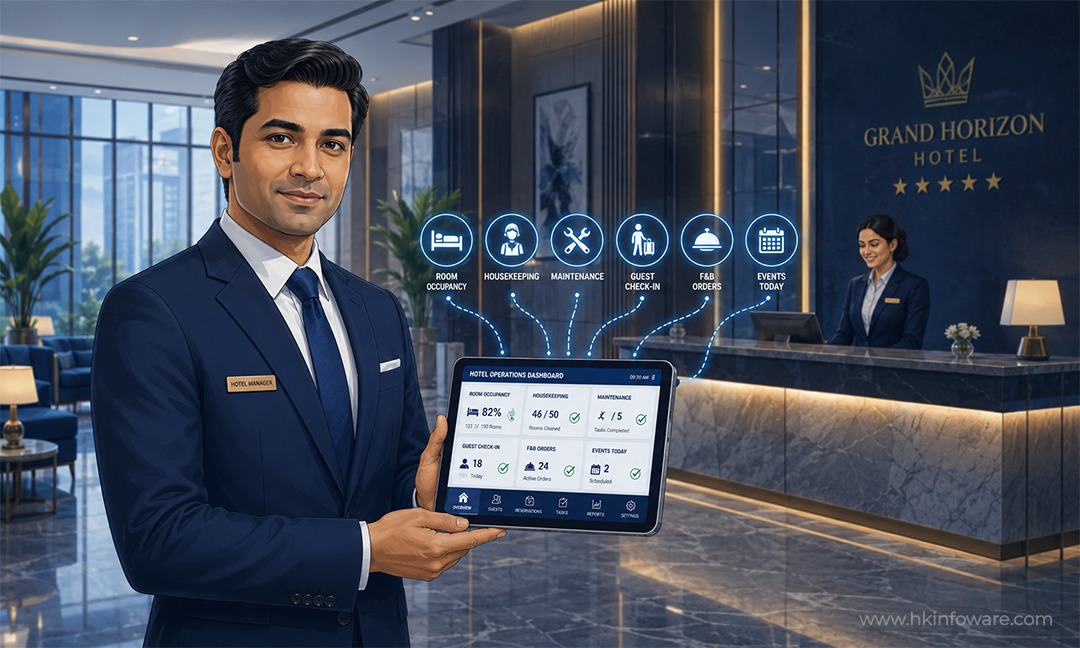
Today, managing a hotel requires much more than a warm welcome and skilled front desk staff. If you’re still leaning on outdated systems, manual registers, or scattered paper logs, you already know the pain: bottlenecked operations, the occasional overbooking nightmare, and billing errors that quietly eat into your margins.
Having hospitality management software that keeps up with the times is essential to being competitive. This software should streamline your daily operations, protect your revenue, and enable you to deliver the kind of guest experience guests talk about afterward.
When assessing hospitality management software, keep the following in mind:
1. Smart Front Desk & Automated Reservation Management
The center of your hotel’s operations is the front desk. A consolidated, real-time dashboard with live room availability, simple guest check-in and check-out options, and occupancy statuses should be provided by your system. Double bookings are avoided, walk-in entries are made easier, and room assignments are easily managed via automated reservation management.
2. True Cloud-Based Access & Device Independence
Being confined to a fixed workstation should not be a part of running your hotel. Hoteliers have total remote access thanks to modern platforms based on cloud PMS technology. You can examine real-time operations, occupancy trends, and financial data from any location in the world using a laptop, tablet, or smartphone.
3. Integrated Commission-free Booking Engine
Due to high commission fees, relying exclusively on Online Travel Agencies (OTAs) reduces your profit margins. Guests can make direct reservations via secure payment gateways and receive instant confirmations thanks to an embedded hotel booking engine that integrates directly with your website.
4. Real-Time Channel Manager Integration
Human mistakes and duplicate reservations result from manually updating accommodation availability across several third-party booking websites. Overbooking issues are immediately eliminated thanks to an integrated channel manager that automatically synchronizes room pricing and inventory across all OTAs and direct channels in real time.
5. Unified Departmental Billing & POS Integration
Hotels lose thousands of dollars due to unpaid room service orders or forgotten bar tabs. Unified Point-of-Sale (POS) integration, which instantly sends charges from eateries, bars, room service, and laundry directly to the guest’s central folio, is a feature of a top-tier system.
6. Automated GST-Ready Compliance & Billing
Long lines and audit compliance issues are caused by manual tax calculations during checkout. In order to achieve complete regulatory compliance, maintain precise financial audit trails, and expedite guest checkout, modern software offers integrated, automated GST-ready invoicing.
7. Digital Housekeeping and Operations Sync
Housekeeping and front desk employees must constantly communicate in order to expedite room turnaround times. Cleaning personnel use mobile devices to update room statuses (cleaned, inspected, or out of order) in real time without making phone calls thanks to digital housekeeping management software.
8. Integrated CRM (Guest Relationship Management)
Providing individualized guest experiences encourages loyalty and return business. Integrated CRM software allows for automated guest communication, feedback gathering, and personalized marketing campaigns by storing guest profiles, stay histories, unique preferences, and contact information.
9. Multi-Property Management Capabilities
It is inefficient to transfer between different accounts if you run several boutique hotels, resorts, or restaurants. Select a platform with multi-property controls so that owners can monitor staff activities, central inventories, and consolidated financial reporting from a single login dashboard.
10. Business Analytics & Real-Time Reporting
Making decisions based on data is essential to optimizing Revenue Per Available Room (RevPAR). Hoteliers may easily increase revenue with the use of advanced technologies that offer customisable daily audit reports, historical occupancy data, dynamic pricing insights, and operational analytics dashboards.
Conclusion
It is now necessary to upgrade to feature-rich, contemporary hospitality management software in order to reduce administrative burden, safeguard profit margins, and increase direct revenue. Hoteliers can remove operational confusion and concentrate on what really matters: delivering exceptional guest experiences by selecting a system like “ HK Star Cloud” that unites front desk, direct booking engines, channel managers, POS billing, and real-time analytics.